
When Are the "End Times"?

In the first article on Revelation, I sought to lay out how we would be approaching the book as a whole. One of the things I said is that Revelation is far less about the “end times” and more about now. This is true, but it also depends on how we are understanding and defining “end times.” Is it possible that the “end times” and “now” are the same thing?
As I pointed out, “end times” is often thought of as the last few days or years before the end of the world. However, the Lord does not speak to us about this as much as we might assume. He does speak about the “end,” the “Last Day,” and the Second Coming, but he is far less interested in giving us the “program” of the last few years and more interested in speaking about the time we are in now, with the Last Day in view.
Sometimes it can throw people off when I say that we are living in the “end times.” By this, I don’t mean we are living “in the last few years before Christ returns,” though that may be true. Biblically speaking, we are in the “end times” now, or as the Bible refers to it: the “last days.” The “last days” is a bit of a buzz word in the New Testament. In the Old Testament, a similar phrase shows up: the “latter days”.
In order to tease this out a bit, let’s look at a few important instances when the OT uses the phrase “latter days” and then we will look at the NT’s use of “last days.”
The Latter Days in the Old Testament
The first place we encounter the “latter days” is in Numbers 24:14, when Balaam is giving his final oracle to Balak:
14 And now, behold, I am going to my people. Come, I will let you know what this people will do to your people in the latter days.”
What follows is a prophecy of the coming of Jesus:
17 I see him, but not now; I behold him, but not near: a star shall come out of Jacob, and a scepter shall rise out of Israel; it shall crush the forehead of Moab and break down all the sons of Sheth.
This prophecy is picking up on language from Genesis 49:10, where another prophecy of Jesus is given. Many see the “star” in Matthew 2:2 as a nod to this passage. Whether that is the case or not, Balaam’s oracle calls the time of the coming of Christ the “latter days.”
The next instance is in Isaiah 2:2:
2 It shall come to pass in the latter days that the mountain of the house of the Lord shall be established as the highest of the mountains, and shall be lifted up above the hills; and all the nations shall flow to it,
Here, we see that the “latter days” are promised to be a time when nations are flowing to the mountain of the house of the Lord. Jesus may have had this in mind when he said in John 12:32:
32 And I, when I am lifted up from the earth, will draw all people to myself.”
Either way, we are in the time when the mountain of the house of the Lord has been established by Christ and the nations are flowing into it.
Bonus thought: Some of you may remember that we related all this language to Genesis 7, where it says the ark was “lifted up” and carried above the waters, which were above the highest mountains of the earth. Isaiah 2 is probably drawing from this language.
The final place we will look at in the OT is in Daniel. There are two passages where this phrase shows up, but we will only look at the one in Daniel 2:28:
28 there is a God in heaven who reveals mysteries, and he has made known to King Nebuchadnezzar what will be in the latter days.
The dream that Neb had was about the coming of the stone kingdom. There are other kingdoms mentioned, but the culmination of the "latter days" is the stone, not made with human hands, which is a reference to Christ.
At this point, from the Old Testament’s perspective, the “latter days” are looking forward to the coming of Christ.
Now let’s look at the New Testament’s version of this phrase, the “last days.”
The Last Days in the New Testament
As we turn to the New Testament, something important to know is that the Greek words for “last days” are the same words that are used in the Greek OT. In other words, we could translate all of these instances in the NT as “latter days.”
In Acts 2:17, at Pentecost, Peter quotes from Joel 2, saying,
17 “And in the last days it shall be, God declares, that I will pour out my Spirit on all flesh,…”
Peter is showing that God had always promised to pour out his Spirit, which is what is being witnessed by the crowds at Pentecost. When would God do this? In the “last days.” Peter is explicitly letting us know that the “last days” (the latter days) have come upon us in the coming of the Son and Spirit.
In 2 Timothy, Paul refers to the “last days” as well. He says in 2 Timothy 3:1-2:
But understand this, that in the last days there will come times of difficulty. 2 For people will be lovers of self, lovers of money, proud…
In the previous verses, Paul has been encouraging Timothy to “flee youthful passions,” “have nothing to do with foolish, arrogant controversies,” and “correct his opponents with gentleness” (2 Tim 2:22-25). This is what sets up his comment about the “last days.” Paul’s use of “last days” is a reference to the time in which Timothy is ministering. It would seem that part of Paul’s point is that he wants Timothy to know what he will be encountering in his ministry. Even though we are in the “last days,” sinfulness will abound.
I have heard some misunderstand this, as if it is referring to a time in the future. However, Paul tells Timothy to “avoid such people” (2 Tim 3:5). If this was a reference to something future, that encouragement from Paul is incoherent. Paul and Timothy are ministering during the “last days.”
One of the most famous times we hear the phrase “last days” is in Hebrews 1. The author starts off his letter/sermon with:
1 Long ago, at many times and in many ways, God spoke to our fathers by the prophets, 2 but in these last days he has spoken to us by his Son…
It should be clear by now that the author of Hebrews is using the phrase in the same way as the other authors. It was prophesied that the Lord would come in the “last days” and he has come and spoken to us by his Son.
Skipping over James 5, where James uses the phrase in the same way, let’s look at 2 Peter 1:3:
I am stirring up your sincere mind by way of reminder, 2 that you should remember the predictions of the holy prophets and the commandment of the Lord and Savior through your apostles, 3 knowing this first of all, that scoffers will come in the last days with scoffing, following their own sinful desires.
This sounds much like Paul, but again, notice that this is not a reference to future time. It’s a reference to the time in which Peter’s audience is living.
There is an interesting connection to 2 Peter and Jude. Some of you may know that there is much overlap in their letters. Without discussing which letter came first, look at what Jude says in Jude 17-18:
17 But you must remember, beloved, the predictions of the apostles of our Lord Jesus Christ. 18 They said to you, “In the last time there will be scoffers, following their own ungodly passions.”
Jude may be referring to 2 Peter or he may just be referring to the general teaching of the apostles. Either way, he seems to be calling the “last days” the “last time.” This might be the closest thing in the Bible to the phrase “end times.” And for Jude, the “end times” are his time.
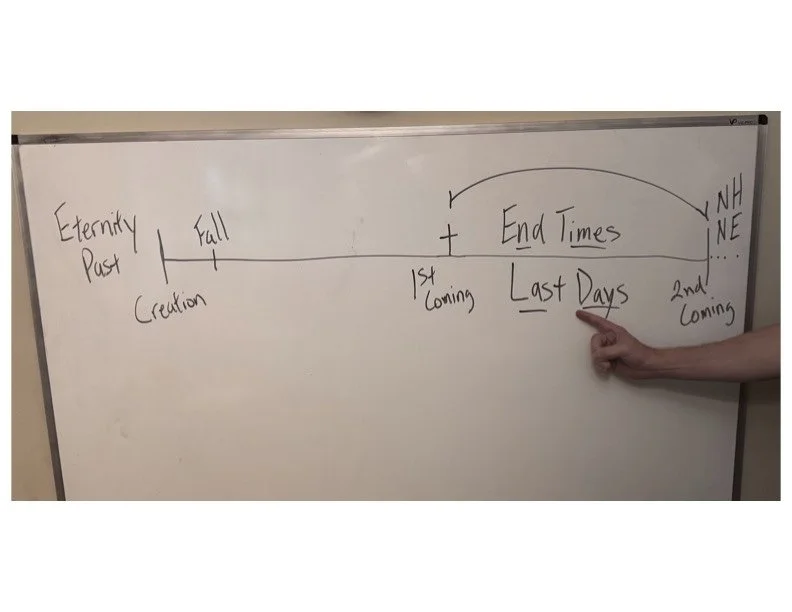
Because a timeline is always helpful, here is what it looks like on a whiteboard:
So What?
Back to the statement, “The book of Revelation is not about the ‘end times.’” I hope it is clear that this statement is both true and false, depending on what we mean by “end times.” According to the Scripture, the “latter days,” “last days, “end times” is the period of time that begins with the first coming of Christ and ends with his Second coming (the Last Day).
Therefore, with this understanding, the book of Revelation is all about the “end times.”