How Should We Then Read...the Book of Revelation?
As you probably know, we are about to begin a sermon series through the book of Revelation. Of all the books of the Bible, Revelation is probably the most mystifying to people and there is some good reason for that. It is not the easiest book to simply pick up and read. The genre of Revelation falls under the category of apocalyptic literature, which we can find difficult to understand.
One of my hopes for our time in the book of Revelation is that it becomes less mystifying to us. This is a gift to the Church from Christ, as is all of Scripture. As the beginning of the book says, we are blessed in the reading of this prophecy. Obviously, the better we understand it, the more we will be blessed!
As we are making our way through Revelation, there will be many questions that arise that may be difficult to answer in a sermon. My plan is to try to answer some of those questions through articles.
This first article is meant to set us on a trajectory for understanding how to read John’s letter. In the history of interpretation, there have been many options proposed for how best to understand John’s structure. Volumes have been written on this topic and my purpose in what follows is simply to provide a little taste of the discussion.
The four approaches below could be considered the four main approaches to reading the book of Revelation. Please recognize that these are somewhat simplified generalizations. There are views within the views and sometimes the various views are given different names. It’s not complex or confusing at all. 😁 I will not be taking the time to evaluate each view in detail (A three-second internet search for “four views of Revelation” will land you in an unending hodgepodge of articles. Have fun!). However, I will be spending significant time on the approach we will be taking in our study of Revelation.
As I begin to lay out these approaches, the question we are asking is: When is the book of Revelation talking about? Notice that it’s a “when” question. How one answers this question determines how the book is understood. Usually, the first three chapters (1-3) and the last two chapters (21-22) share much agreement between the views. It is chapters 4-19 that are typically the area of debate. Here are the four main answers:
Futurist Approach
For the futurist, when is the book of Revelation talking about? Mainly, the future.
If you are familiar with dispensational theology, which argues for a rapture and a seven-year tribulation time just prior to the return of Christ, then you are probably familiar with this approach to the book. Generally, chapters four through nineteen are seen as prophesying of the seven-year tribulation period, culminating in the Second coming of Christ. Chapter twenty begins the time of the millennial kingdom, where Christ reigns upon a literal throne in Jerusalem. Then the end of chapter 20, and the rest of the book, speak of the final judgment and the New Heavens and the New Earth. As you can probably tell, this view tends to read the book of Revelation in a literal, chronological fashion.
It's probably the case that when most people think of the book of Revelation, this is how they think of it. The average person tends to think that the book of Revelation is about the “end times” (see article). And what they mean is that it is about the very last years or events before the end of the world. Sometimes it is asserted that, though the book can be of help to us now, it is not really for us, but for the people who will go through the seven-year tribulation period.
This was the view I was first introduce to. I spent many years studying this and even teaching it at times. As I became less convinced of dispensational theology, my understanding moved to the next approach.
Preterist Approach
For the preterist, when is the book of Revelation talking about? Mainly, the past.
The preterist approach to reading Revelation is almost the exact opposite of the futurist. The preterist sees all (or most) of the prophecy conveyed in John’s letter, especially chapters four through nineteen, to be related to the fall of Jerusalem in 70AD. This approach requires an early date of the book, at least before the events of 67-70AD, when Rome brought destruction to much of Israel and especially the city of Jerusalem.
The preterist tends to see much overlap with the Olivet Discourse (Matt 24, Mark 13 and Luke 21), where Jesus is speaking about the fall of Jerusalem. They tend to also read the book in a more chronological, though not woodenly literal, fashion. Some preterists even see the fall of the Roman empire (476AD) as part of the prophecy.
I held this view for many years, and there are many aspects of this view that are appealing, but over the years, I have found this to be less convincing. For one, the date of Revelation is almost certainly in the 90’sAD.
Historist Approach
For the historist, when is the book of Revelation talking about? Depends. Where, in time, do you think we are in the book?
This approach to the book tends to see the book of Revelation as speaking about the time between Christ’s first coming and his second coming. The visions are typically understood to correspond to historical events from the first century to the end of time. Thus, Revelation is read chronologically. This means that, depending on which events you think are being prophesied, you can determine where you are in time in the book (for example, some historists have claimed that Atilla the Hun is referred to in chapter sixteen). We might be in chapter eight or thirteen, but more than likely closer to the end. Who knows! They disagree amongst themselves.
I am sure that there are those that could make some good arguments for this view, but I have never held this view and find it to be the least convincing.
Progressive Recapitulation Approach
For the progressive recapitulationist, when is the book of Revelation talking about? Mostly now, with an eye to the first and second coming of Christ.
This approach has the least pithy name (and is probably considered under the “idealist” approach). However, the name is trying to capture how to approach the book. This view sees the book of Revelation as describing “seven snapshots” of the same event or time period, which is repeated (recapitulated) every few chapters in the book. That “time period” is the time between the first and second coming of Christ (in other words, “now”). The “snapshots” often begin with a reference to the first coming, which can include Christ’s incarnation, death, resurrection or (especially) ascension. Then it concludes with a reference to the Second Coming, which includes some reference to final judgment and salvation. This pattern is repeated over and over, with a progressive intensification of the scenes.
This is the approach we will be taking in our study. This might be the least-well-known to most of you, but it is probably the most widely held position in Reformed circles today. It takes a little (or a lot of) explaining to grasp this perspective. Though the Scriptures are (and the first century reader would have been) familiar with this type of writing, this is not how we tend to read…anything.
The rest of our time will be laying out how Revelation is structured. I cannot explain everything, so this will just be a beginning.
The General Outline
In William Hendrickson’s little book on Revelation, More Than Conquerors (p16-18), he lays out “Seven Parallel Sections.” Sometimes you will hear me say “Seven Snapshots.” That’s the same thing. And the exact places where these sections begin and end can be debated, but we will just use his outline for ease.
1. Christ in the Midst of the Lampstands (1:1 – 3:22)
2. The Vision of Heaven and the Seals (4:1 – 7:17)
3. The Seven Trumpets (8:1 – 11:19)
4. The Persecuting Dragon (12:1 – 14:20)
5. The Seven Bowls (15:1 – 16:21)
6. The Fall of Babylon (17:1 – 19:21)
7. The Great Consummation (20:1 – 22:21)
These snapshots are looking at the same time period between the first and second coming of Christ. Think of it as seven pictures of the same thing from various angles. This is often difficult for us to grasp because, if you’re like me, you like things to be chronological (you know I love timelines!). But John has not written in this way. We can have a talk with him about this in eternity.
According to G.K. Beale, “The strongest argument for the recapitulation view is the observation of repeated combined scenes of consummative judgment and salvation found at the conclusions of various sections throughout the book. The pattern of these scenes is always the same, consisting of a depiction of judgment followed by a portrayal of salvation; cf. respectively 6:12-17 and 7:9-17; 11:18a and 11:18b; 14:14-20 and 15:20-24; 16:17-21, including 17:1 – 18:24” (Beale, 121)
Another way to say this is that the end of the world, with both judgment and salvation, is described multiple times throughout the book, and these serve as markers for divisions in the book. Similar language is used each time and there is usually an intensification.
I assume that an example of this “recapitulated” language will be helpful.
The Wrath of God, Recapitulated
Let’s begin by looking at the language from Revelation 19, where Christ comes on a white horse. It says, “He will tread the winepress of the fury of the wrath of God the Almighty” (19:15b).
I would imagine that there is very little disagreement that what is being described is the Second Coming of Christ, as he comes in judgment upon the world and brings salvation to his people. However, this is not the first time that the “wrath of God” is mentioned as coming upon the world. Nor is it the first time that even the “winepress” imagery is used. Look at some other times that this is mentioned:
Revelation 6:17 — “for the great day of their wrath has come, and who can stand?”
Revelation 11:18 — “The nations raged, but your wrath came, and the time for the dead to be judged,”
Notice that it is time for the dead to be judged, which is also mentioned later in the book as the final judgment (20:13).
Revelation 14:19-20 – “So the angel swung his sickle across the earth and gathered the grape harvest of the earth and threw it into the great winepress of the wrath of God. And the winepress was trodden outside the city, and blood flowed from the winepress, as high as a horse’s bridle, for 1,600 stadia.”
Revelation 16:19-20 – “The great city was split into three parts, and the cities of the nations fell, and God remembered Babylon the great, to make her drain the cup of the wine of the fury of his wrath. And every island fled away, and no mountains were to be found.”
So the great day of the wrath of God comes multiple times in the book. And this is not the only language that overlaps (is recapitulated). The sky and the islands are often doing similar things in these great scenes of judgment. Earthquakes, lightning and hail show up multiple times as well. Also, this is not limited to just the description of judgment. The language of salvation is also repeated and intensified.
As we become more familiar with John’s language and allow our eyes to scan through the various scenes, we will begin to see more clearly that John is talking about the same event multiple times from various perspectives.
One Snapshot for Clarity
If it is true that John is giving us snapshots of the first and second coming, and something of the time in between, then we should be able to discern when the new snapshot begins and ends, which correspond to the outline given above. The easiest place to see this is when you move from chapter eleven to chapter twelve.
Chapter eleven ends with a grand picture of judgment: the wrath has come and the time for the dead to be judged has arrived (11:18a); and a grand picture of salvation is given: the time for the rewarding of the servants, prophets and saints (11:18b). This sounds very much like the last day, the final judgment, etc.
As you begin chapter twelve, we are given a new, different scene that brings us back to the first coming. It pictures a woman ready to give birth. Then this happens: “She gave birth to a male child, one who is to rule all the nations with a rod of iron, but her child was caught up to God and to his throne” (12:5). It is unmistakable that the vision given is of Christ’s incarnation, death, resurrection and ascension. This is John’s pithy way of describing all of that!
The effect of Christ ascending to his throne is that Satan is thrown down to the earth and is no longer in a position to accuse the Lord’s people. They have conquered him by the blood of the lamb.
Without walking through this whole snapshot, notice what happens at the end of chapter fourteen. It’s the great day of the harvest, with judgment and salvation (14:14-20). Then chapter fifteen starts over with “another scene.”
As we make our way through the book of Revelation, these “scenes” and their divisions will become clearer. The relationship between the various scenes is fascinating and complex at times, but we will do our best to understand what the Lord is saying to his Church!
The Ascension
I have one final thought to leave you with. A question of John’s gospel is often, “How come he does not mention the ascension?” There are probably a few possible answers we could offer, but consider this one:
One of the emphases of the book of Revelation is the reality of the ascension of Christ to his throne.
In chapter one, it is assumed and alluded to multiple times. Jesus is said to be “coming on the clouds” (1:7). This is a direct reference to Daniel 7:13, which is speaking about the ascension of Christ. He is described in his glorified, exalted state (1:12-16) and is said to have the “keys of Death and Hades” (1:18). John is meeting with the one who has been raised up from the dead and has ascended to his throne.
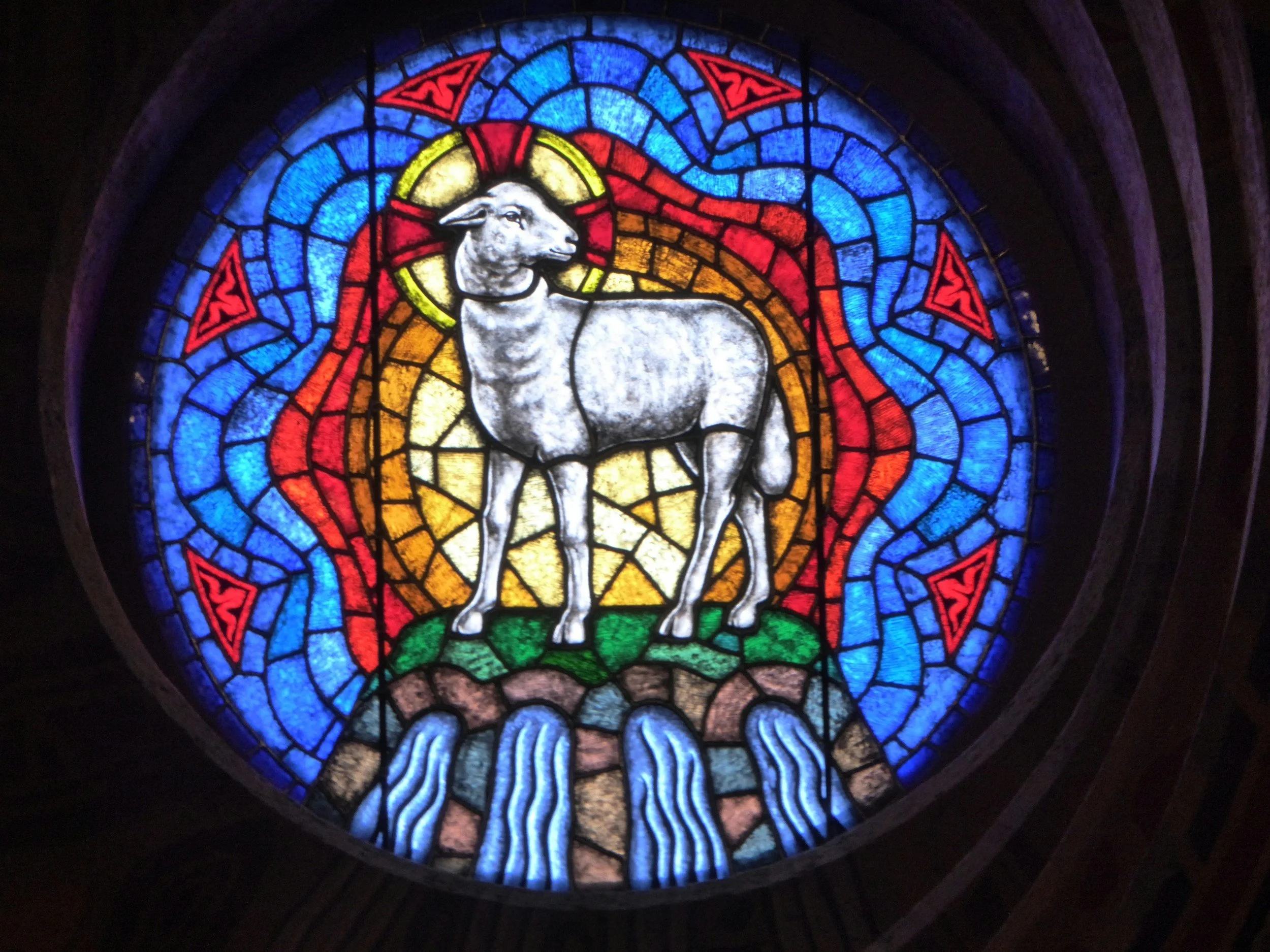
Chapters four and five are a description of the ascension of Christ (especially chapter 5). The lamb who was slain is given the scroll (5:8), and now sits upon his throne, where he is worthy of blessing, honor, power and dominion.
Chapter twelve, which we have already looked at, says that he was “caught up to God and his throne” (12:5). And the effects of his ascension are described in what follows.
Chapter twenty opens with an “angel” coming and binding Satan (compare this with similar themes in chapter twelve). This is the beginning of a new scene and a reference to the first coming of Christ. In Jesus’ own words, he bound Satan (Matt 12:28-29) and as Revelation 20 says, it was for a specific purpose: so that he is unable to deceive the nations any longer (20:3). This again, is all the result of Christ taking his heavenly throne in his ascension. (I am not sure if Kelly agrees with our approach, but this article might interest you!)
These, and many other passages in the book of Revelation, are meant to deliver to the saints on earth the heavenly reality that Christ is, indeed, upon his throne, ruling and reigning with all power and authority.
Perhaps the reason John does not mention the ascension in his gospel is because that was being saved for a whole book. Whether John thought of it this way or not, that is the reality put before us in Revelation.
The book of Revelation is far less about the “end times” and far more about the Lamb upon his throne and what that means for us now. This is what we will be seeing as we make our way through this most mystifying book!